
FORMULATION AND EVALUATION OF EFFERVESCENT MOUTHWASH TABLET FOR ORAL HYGIENE APPLICATIONS
Neeleshwari Parmar
Email : parmarneeleshwari@gmail.com
ABSTRACT
Oral health and hygiene play a vital role in overall health and well-being. various liquid mouthwash is available and used mostly for the oral hygiene, but they contain excess amount of alcohol, they have an unpleasant taste, they are difficult to handle carefully. To overcome these problems caused by liquid mouthwashes, an effervescent Mouthwash Tablet was formulated and also Evaluated them. In the preparation of the tablets, we have used Direct compression method.
In This Effervescent tablet formulation, we have used various ingredients and excipients such as Mannitol, polyvinylpyrrolidone (PVP), peppermint oil, menthol, talc, and magnesium stearate, sodium saccharin, also effervescent agents are used such as citric acid, tartaric acid and sodium bicarbonate also various evaluation parameters are carried out in two parts pre compression parameters and post compression parameters respectively. The parameters included angle of Repose, bulk density, tapped density, carr’s compressibility index and Hausner’s ratio, general Appearance, weight Variation, hardness, thickness etc. After all the evaluation parameters carried out the outcomes the obtained results were satisfactory for making a Effervescent Mouthwash Tablets. The prepared tablets exhibited adequate mechanical strength, uniformity, rapid effervescence, and good stability. The study concluded that effervescent mouthwash tablets can be considered a convenient, stable, and patient-friendly alternative to conventional liquid mouthwash formulations for maintaining oral hygiene.
Keywords: Effervescent mouthwash tablet, Oral hygiene, Direct compression, Effervescence, Mouthwash formulation, pre-compression evaluation, post-compression evaluation
INTRODUCTION
Oral health is an essential part of overall health and well-being. It plays an important role in maintaining functions such as chewing, speaking, tasting food, and social interaction. Poor oral hygiene can lead to several oral diseases such as dental caries, gingivitis, periodontal diseases, and halitosis. These oral conditions not only affect the oral cavity but may also influence general health and quality of life. Therefore, maintaining proper oral hygiene is important for preventing oral infections and improving
overall health status.
Mouthwashes are widely used as an adjunct to regular tooth brushing and flossing for maintaining oral hygiene. Mouthwash helps in the prevention of various diseases. The mouthwashes are also used for the freshening breath. mouthwashes are liquid dosage forms, that contains alcohol and some harmful substances they also have various disadvantages like bad taste, problem in transportation, also they do not have unit dose. They are unstable too and have storage limitations too.
To overcome these limitations, the study has been carried out and developed an alternate dosage form for the mouthwashes i.e. Effervescent Mouthwash Tablets which is a solid dosage form which contains very less amount of alcohol and does not require alcohol as a vector. The Effervescent Mouthwash Tablet dissolves in water and is used as a mouthwash avoiding the various side-effects caused by alcoholic solutions and the effervescent tablet contains citric acid, sodium bicarbonate, and tartaric acid is being used as effervescent agents.
The Effervescent Mouthwash Tablets has various advantages like it provides unit dose as a tablet contains a calculated amount of ingredients in the tablet various excipients are used such as Mannitol, polyvinylpyrrolidone (PVP), sodium saccharin, peppermint oil, Menthol, talc and magnesium stearate is used and these tablets are also easy to handle and safe to use.
The Effervescent Mouthwash Tablets are prepared by Direct compression method which is an easy method for the preparation of the Tablets and the tablets prepared by Direct compression method was evaluated and various parameters are observed such as Angle of Repose, bulk Density, tapped Density, Carr’s compressibility index, Hausner ratio, hardness, thickness, weight Variation, Effervescence Time and Moisture content of the tablet.
The study aimed to formulate a stable, convenient and patient friendly alternative of liquid mouthwashes for oral Hygiene application. This study also aims for evaluation of those tablets.
MATERIAL AND METHOD
Table No.: - 1. Formulation Used
|
S.No. |
Ingredient |
Quantity |
|
1 |
Citric Acid |
6 gm |
|
2 |
Sodium bicarbonate |
9gm |
|
3 |
Tartaric Acid |
4.5gm |
|
4 |
Mannitol |
4.5gm |
|
5 |
PVP (Polyvinylpyrrolidone) |
0.9gm |
|
6 |
Sodium saccharin |
0.3gm |
|
7 |
Peppermint oil |
0.15ml |
|
8 |
Menthol |
0.15ml |
|
9 |
Talc |
0.6gm |
|
10 |
Magnesium stearate |
0.3gm |
Procedure for Effervescent tablets
The Effervescent Mouthwash Tablets are prepared by the Direct Compression method with controlled humidity and temperature which help in prevention of premature effervescent reaction firstly, citric acid and tartaric acid, were accurately weighed and drying is conducted if required and passed through the sieve for the uniform particle size. Then another mixture is prepared which contains sodium bicarbonate and mannitol which are also weighed and sieved separately.
Then the mixture was blended and other ingredients such as sodium saccharin (sweetener), peppermint oil and menthol (for flavour and mouthfeel) were added properly with uniform mixing. Finally, lubricant and Glidant are added as talc and magnesium stearate respectively and mixed properly. The mixture was blended to avoid the excess lubrication.
The prepared blend was poured into the hopper of the compression machine and then the machine compressed the powder as direct compression method is used and then the tablets are punched into the dies properly in a uniform size and uniform weight. Then the punched tablets are used and stored in a airtight container to prevent them from moisture and for the good stability of the tablets and is stored in the desiccator.
Then the mentioned evaluation parameters are conducted for making sure that the ideal tablets are prepared and the tablets prepared have proper shape size and weight also the blends are also checked
The tablet compression machine operated using ‘B tooling’ it has 10 punching stations in it. The RPM of the compression machine can be regulated as when we were performing this practical it was 25-35 RPM also it can go up to much higher RPM. This machine can produce around 2000-18000 tablets per hour. The maximum tablet diameter of the machine is 16mm. Also, the maximum operating pressure and maximum pre-operating pressure is 6ton and 1 ton respectively. This machine tools are made up of stainless steel.
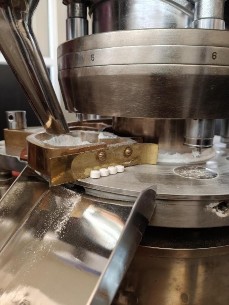
Figure 1: - Tablet Compression
EVALUATION PARAMETERS
Pre-Compression Evaluation Angle of Repose
The Angle of Repose was determined for flow properties of powder and flow should be accurate for the
proper flow of the powder firstly a funnel is kept in the tripod stand and then is kept into a paper or a flat surface then the powder is poured into the funnel to form a cone of the powder. Then the height and radius of the powder cone were measured and the angle of Repose was calculated

Bulk Density
Density is known as the Mass divided by volume as we have to determine the bulk density of the powder blend which is determined using a measuring cylinder and a weighted powder which poured into the measuring cylinder to know the volume of the powder then bulk density is calculated by dividing the weight of powder by volume as the bulk volume is calculated then the voids are also been covered in bulk density

Tapped Density
Tapped density is simply the density of the powder but without the voids as we know density is mass/volume then the mass would be the same as being weight and the volume of powder to be determined by tapping the measuring cylinder and clearing the voids from the powder then the mass/tapped volume is been calculated.
Carr’s Compressibility Index
Carr’s Compressibility Index was calculated by the values obtained as bulk Density and tapped density of the powder prepared.
Hausner Ratio
Hausner ratio was also determined/calculated by tapped Density and bulk density to evaluate the flow characteristics of the powder used
Post-Compression Evaluation General Appearance
The Effervescent Mouthwash Tablets are inspected by looking and observation in which the color , shape
surface smoothness and cracks and defect are observed properly.
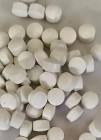
Figure 6: - General Appearance
Weight Variation
Weight Variation is determined by the weighing of the individual tablets. Min. 20 tablets to be weighed carefully and then average of weight of the 20 tablets is being determined and then the weight of the individual tablets is been compared with the average weight of the tablet
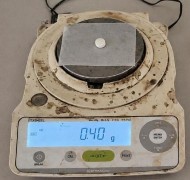
Figure 7 :- Weight Variation
Effervescence Time
Take 200ml of water in a beaker then dip one tablet in the beaker and simultaneously turn on the stopwatch to record the time at how much time do the tablets are been dissolved / dispersed in the water
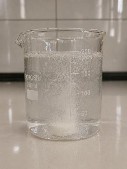
Figure 8:- Effervescence Test
Moisture Content
The tablet is weight properly and then stored in the desiccator and in every 15 min the tablet weight is checked and to be kept untill the same weight to come in next 3 readings.
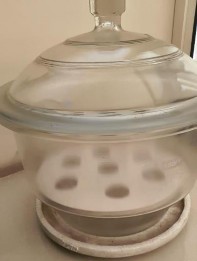
Figure 9:- Desiccator
Table: 02 Evaluation Table
|
S. No. |
Evaluation Parameters |
Observation |
|
1. |
Angle of Repose |
28.6° |
|
2. |
Bulk Density |
0.51 g/mL |
|
3. |
Tapped Density |
0.64 g/mL |
|
4. |
Carr’s Compressibility Index |
20.18% |
|
5. |
Hausner Ratio |
1.25 |
|
6. |
General Appearance |
White, round, smooth tablets |
|
7. |
Average Weight |
0.42 g (420 mg) |
|
8. |
Hardness |
3.33 kg/cm² |
|
9. |
Thickness |
3.8 mm |
|
10. |
Effervescence Time |
87.6 sec |
|
11. |
Moisture Content |
0.3% |
|
12. |
pH |
6.2 |
RESULT
AND DISCUSSION
The mouthwash effervescent tablets are formulated successfully by Direct compression method and evaluated in two categories pre-compression and post-compression parameters. The results are found to be:
-
Angle of Repose 28.6°
-
Bulk Density 0.51 g/mL
-
Tapped Density 0.64 g/mL
-
Carr’s Compressibility Index 20.18%
-
Hausner Ratio 1.25
-
General Appearance White, round, smooth tablets
-
Average Weight 0.42 g (420 mg)
-
Effervescence Time 87.6 sec
-
Moisture Content 0.3%
The Tablets which are formed shows all the results in its limitations and show good flow properties and a stable product. The tablets meet its criteria.
CONCLUSION
In the study conducted the Effervescent Mouthwash Tablets are formulated successfully by Direct compression method using ingredients. The powder and tablets both are evaluated successfully and the prepared tablets are stable and efficient. The Tablets which are prepared as an average weight of 420mg The overall result found to be the developed formulation meets its requirements and quality standards and is suitable and patient – friendly drug delivery.
REFERENCES
-
Arkhade BC, Ouedraogo S, Kadiatou T, et al. “Formulation and characterization of effervescent tablets from traditional medicine for dental care.” International Journal of Applied Pharmaceutics. 2025;17(6):388–394.
-
Chatzidopavlaki P, Triantafyllopoulou E, Pippa N, Valsami G. “Recent advances in the technology of effervescent tablets: lessons learned and future perspectives.” RSC Pharmaceutics. 2025;2:8– 18.
-
Narsale S, Deshmukh K, Chavan R. “Formulation and evaluation of effervescent tablets.” International Journal of Pharmacy and Pharmaceutical Science. 2025;7(1):311–315.
-
McGrath C, Clarkson J, Glenny AM, Walsh LJ, Hua F. “Effectiveness of mouthwashes in managing oral diseases and conditions: Do they have a role?” International Dental Journal. 2023;73(S1):S69-S73.
-
Patel S, Siddaih M. “Formulation and evaluation of effervescent tablets: a review.” Journal of Drug Delivery and Therapeutics. 2018;8(6):296–303.
-
Yap AU. “Oral health equals total health: A brief review.” Journal of Dentistry Indonesia. 2017;24(2):59-62.
-
Nayak AK, Pal D, Santra K. “QbD approach: tablet compression process optimization using design of experiments.” International Journal of Pharmaceutical Sciences Review and Research. 2016;38(2):45-53.
-
Allen LV. “Effervescent tablets. In: Pharmaceutical Dosage Forms and Drug Delivery Systems”. 10th ed. Philadelphia: Lippincott Williams & Wilkins; 2013.
-
Srinath KR, Chowdary CP, Palanisamy P. “Formulation and evaluation of effervescent tablets of paracetamol.” International Journal of Pharmaceutical Research and Development. 2011;3(3):76– 104.
-
Bahr MN. “A design of experiments for tablet compression.” Pharmaceutical Technology. 2011;35(10):104–110.
-
Marsh PD. “Dental plaque as a biofilm and its role in oral health and disease.” BMC Oral Health. 2006;6(Suppl 1):S14.
-
Petersen PE, Bourgeois D, Ogawa H, Estupinan-Day S, Ndiaye C. “The global burden of oral diseases and risks to oral health.” Bull World Health Organ. 2005;83(9):661–669.
-
Eley BM. “Antibacterial agents in the control of supragingival plaque: a review.” British dental Journal. 1999;186(6):286–296.
-
Addy M. “Chlorhexidine compared with other locally delivered antimicrobials in the management of periodontal disease.” Journal of Clinical Periodontology. 1986;13(10):957–964.
-
Aulton ME, Taylor K. “Aulton’s Pharmaceutics: The Design and Manufacture of Medicines”. 5th ed. Elsevier; 2018.
-
Banker GS, Anderson NR. “Tablets. In: The Theory and Practice of Industrial Pharmacy.”3rd ed. Mumbai: Varghese Publishing; 1987.