
FORMULATION DEVELOPMENT AND EVALUATION OF TRANSDERMAL DRUG DELIVERY SYSTEM OF LIPOSOMES
Gaurav Chouhan
Email ID : chouhang31@gmail.comABSTRACT
Arbutin, a beta-D-glucopyranoside of Hydroquinone, is a plant extract from the dried leaves of bearberry plants. It is commonly used in skincare and cosmetic products as a skin-lightening agent to prevent melanin formation in skin conditions. Arbutin is also used as an anti-infective for the urinary system and a diuretic. It is available in natural and synthetic forms and is a competitive inhibitor of tyrosinase in melanocytes. It is less cytotoxic to melanocytes in culture compared to Hydroquinone. The study aims to develop and evaluate a transdermal patch for skin whitening using Arbutin, a non-steroidal anti-inflammatory drug. The patch will be a self- contained dosage form that delivers the drug at a controlled rate to the systemic circulation. This will avoid first-pass metabolism and enhance bioavailability. The system will also improve patient compliance by avoiding hazards and discomfort associated with parenteral therapy. It will provide therapy for longer periods with controlled levels in the plasma, reducing repeated dosing intervals and potential side effects. The system will be non-invasive, free from contamination, and non-irritant compared to parental methods. The prepared transdermal drug delivery system of Arbutin using polymer had shown good promising results for all the evaluated parameters. Based on the In-vitro drug release and drug content Result, formulation F5 was concluded as an optimized formulation, which shows its higher percentage of drug release.
Keywords: Arbutin, Hydroquinone, transdermal patch, bioavailability, beta-D- glucopyranoside.
INTRODUCTION
Arbutin, a beta-D-glucopyranoside of Hydroquinone, is a plant extract from the dried leaves of bearberry plants. It is commonly used in skincare and cosmetic products as a skin-lightening agent to prevent melanin formation in skin conditions. Arbutin is also used as an anti-infective for the urinary system and a diuretic. It is available in natural and synthetic forms and is a competitive inhibitor of tyrosinase in melanocytes. It is less cytotoxic to melanocytes in culture compared to Hydroquinone (1-3).
The study aims to develop and evaluate a transdermal patch for skin whitening using Arbutin, a non-steroidal anti-inflammatory drug. The patch will be a self-contained dosage form that delivers the drug at a controlled rate to the systemic circulation. This will avoid first-pass metabolism and enhance bioavailability. The system will also improve patient compliance by avoiding hazards and discomfort associated with parenteral therapy. It will provide therapy for longer periods with controlled levels in the plasma, reducing repeated dosing intervals and potential side effects. The system will be non-invasive, free from contamination, and non- irritant compared to parental methods.
MATERIALS AND METHODS
Formulation of Transdermal Patches
The patch was prepared by dissolving polymers and plasticizers in solvents, then transferred to a glass bangle wrapped in aluminum foil. The patches were left undisturbed for 24 hours, then retrieved intact and stored in a desiccator for further evaluation. The patch consists of drug, polymers, plasticizer to optimize the formulation development. The matrix Transdermal patches containing extract of different ratios from F1-F5, were prepared by solvent casting technique employing mercury as substrate. The casting solutions were prepared by dissolving appropriate polymers and plasticizers in suitable solvents using magnetic stirrer for 20 min to get uniform dispersion. The casting solutions were prepared by sprinkling weighed amount of gelatine in 10 ml of distilled water and was kept aside for 15 minutes then measured amount of glycerine was added and heated to 60°C until gelatine dissolves. Plasticizer was added at a concentration of 30% w/w of polymers. The solution was then transferred quantitatively to glass bangle kept wrapped with aluminum foil in petridish. Controlled solvent evaporation was achieved by placing an inverted funnel over the petridish. These were left undisturbed at room temperature for 24 hours. The patches were retrieved intact by slow lifting of the rings from these aluminum foil and were kept in desiccator for the further evaluation (4-6).
Table 1: Formulation composition of Transdermal Patch
|
Ingredients |
Formulation Batches |
||||
|
F1 |
F2 |
F3 |
F4 |
F5 |
|
|
Arbutin (mg) |
100 |
100 |
100 |
100 |
100 |
|
Polymer: HPMC (w/v) (mg) |
0.5 |
1 |
1.5 |
2 |
2.5 |
|
30% w/w Plasticizer: (Polyethylene glycol) (ml) |
5 |
4 |
3 |
2 |
1 |
|
Casting Solvent (q.s.) (ml) |
10 |
10 |
10 |
10 |
10 |
Evaluation of Transdermal Patches
Transdermal patches are a method of drug delivery that allows for controlled, slow release of medication through the skin, bypassing the digestive system. The unique formulation of these patches allows for drug penetration through the skin barrier. Design considerations include
material selection, size, shape, and thickness. Characterization tests assess drug content uniformity, adhesive properties, permeation rate, and stability to ensure consistent doses over time (7-10).
RESULTS AND DISCUSSION
Evaluation of Transdermal Patches
The patch thickness ranges from 0.429 to 0.512 mm, with weight variations from 141 to 148 gm. The hardness ranges from 244 to 248 Pascals, with values for all formulations. The tensile strength ranges from 0.5080 to 0.5727 Kg/m3, with values for all formulations. The folding endurance ranges from 267 to 270 units, with values for all formulations. Moisture uptake ranges from 5.013 to 5.050%, with values for all formulations. The drug content ranges from 89±0.3 to 90±0.5%, with values for all formulations. The graphs provide a comprehensive analysis of the patch's properties, including thickness; weight variation, hardness, tensile strength, folding endurance, moisture uptake, and drug content (Table 2).
Table 2: Physiochemical properties of prepared formulation
|
Patches |
Thickness (mm) |
Weight uniformity (mg) |
Hardness (Pascal) |
Tensile Strength (Kg/m3) |
Folding endurance |
Moisture uptake |
Drug content (%) |
|
F1 |
0.4297±020 |
141.7±1.20 |
244.0±2.0 |
0.5080±0 |
267.3±0.66 |
5.013±0.8 |
79.80±0.4 |
|
28 |
2 |
82 |
.5773 |
67 |
819 |
583 |
|
|
F2 |
0.4657±0.28 |
147.7±0.88 |
246.0±2.5 |
0.5197±0 |
266.7±0.88 |
5.020±0.1 |
80.63±0.9 |
|
48 |
19 |
17 |
.1202 |
19 |
528 |
770 |
|
|
F3 |
0.4970±0.26 |
144.7±0.57 |
247.0±0.5 |
0.5780±0 |
266.3±1.85 |
5.040±0.2 |
80.27±0.4 |
|
46 |
8 |
774 |
.5773 |
6 |
646 |
978 |
|
|
F4 |
0.5040±0.15 |
141.0±0.87 |
246.0±1.1 |
0.5690±0 |
270.0±1.01 |
5.060±0.3 |
80.53±1.0 |
|
28 |
8 |
55 |
.8819 |
0 |
055 |
48 |
|
|
F5 |
0.5127±0.12 |
148.0±0.61 |
248.0±0.5 |
0.5727±0 |
270.0±0.57 |
5.050±0.3 |
80.23±0.4 |
|
0 |
9 |
7 |
. |
7 |
7 |
In vitro Drug Release
To elucidate the mechanism of the active diffusion and diffusion of Extract from drug loaded patches for transdermal administration, in vitro drug diffusion study using Franz diffusion cell have been performed. The temperature was controlled at 32°C. Phosphate buffer (pH 7.4) was used as diffusion medium. Optimized batch showed steady state diffusion through 24 hours. This slow diffusion rate will maintain the concentration of Extract drug up to 24 hours. The cumulative percent drug was released from formulation batch of F1, F2, F3, F4 and F5 were
59.200 ± 0.6004. 61.350 ± 0.5501, 79.050 ± 0.5492, 89.100 ± 1.000 and 96.250 ± 0.6515
respectively. The maximum percent cumulative drug release was shown by F5 formulation. It is clear that the patches showed optimum drug release up to 24 hrs. The permeation data fitted in zero order drug release indicating controlled release of the Extract from the formulations. It is observed that smaller pores size in the matrix derived from patches tend to fuse readily in the skin, polymer content resulted as a barrier for drug release and helped as a controlled release and also decrease drug leakage (Figure 1).
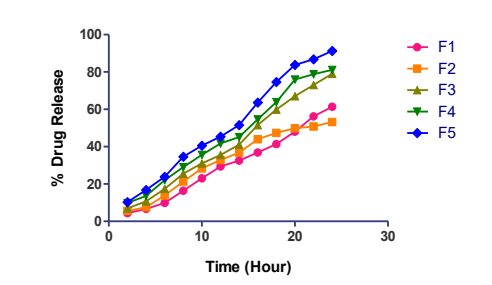
Figure 1: In vitro drug diffusion studies
Stability Studies
Stability of the drug has been defined as ability of the formulation in specific container, to remain within its physical, chemical, therapeutic and toxicological specifications. The purpose of stability was to provide evidence on the quality of the drug substance or drug product which varies with time under the influence of the variety of factors such temperature and humidity. Stability studies were conducted according to the ICH Q1A (R2) guidelines; the formulation in container wrapped in aluminum foil and were kept in stability chamber at temperature 40°
± 2°C and 75% ± 5 RH and at room temperature for 1 month. Samples were withdrawn at the end of the month and were analyzed for drug content (Table 4).
Table 3: Influence of storage condition and storage duration on drug content and particle size for 1 month at accelerated temperature (40° ± 2°C and 75% ± 5 RH) and room temperature.
|
Time Duration |
Drug Content (%) |
|
|
(Days) |
At Room Temp. |
At Accelerated Temp. |
|
30 |
88.2 |
87.9 |
CONCLUSIONS
The prepared transdermal drug delivery system of Arbutin using polymer had shown good promising results for all the evaluated parameters. Based on the In-vitro drug release and drug content Result, formulation F5 was concluded as an optimized formulation, which shows its higher percentage of drug release.
CONFLICT OF INTEREST
None
REFERENCES
-
Reanmongkol, W.; Noppapan, T.; Subhadhirasakul, S. Antinociceptive, antipyretic, and anti-inflammatory activities of Putranjiva roxburghii Wall. leaf extract in experimental animals J. Nat. Med. 2009, 63, 290- 296.
-
Shahwar, D.; Raza, M. A; Saeed, A.; Riasat, M.; Chattha, F. I.; Javaid, M.; Ullah, S.; Ullah, S. Antioxidant potential of the extracts of Putranjiva roxburghii, Conyza bonariensis, Woodfordia fruiticosa and Senecio chrysanthemoids. Afr. J. Biotechnol. 2012, 11, 4288-4295.
-
Khandelwal KR. Practical pharmacognosy. 15th edition. Nirali prakashan, pune 2006;15:149-56.
-
Sharma A, Sisodia SS. Preliminary Phytochemical Evaluation of Aerial Parts of Sphaeranthus indicus Linn.(Asteraceae). IJP, 2022; Vol. 9(2): 36-40.
-
Valeveti SK, Pashikanti S. Design, development, and evaluation of transdermal patches containing memantine hydrochloride. Int J App Pharm. 2023;48481:181-97.
-
Purnamasari N, Alatas F, Gozali D. Formulation and evaluation of diclofenac potassium transdermal Patch. J Ilmiah Farmasi. 2019;7(1):43-8.
-
Hardainiyan S, Kumar K, Nandy BC, Saxena R. Design, formulation and in vitro drug release from transdermal patches containing imipramine hydrochloride as model drug. Int J Pharm Pharm Sci. 2017;9(6):220-5.
-
Reveny J, Sumaiyah S. Formulation and evaluation of in vitro transdermal patch diclofenac sodium using chitosan polymer and polyvinyl alcohol cross-linked tripolyphosphate sodium. Asian J Pharm Clin Res. 2018;11(8):171.
-
Allena RT, Yadav HKS, Sandina S, Prasad SC. Preparation and evaluation of transdermal patches of metformin hydrochloride using natural polymer for sustained release. Int J Pharm Pharm Sci. 2012;4:297-302.
-
Patel DJ, Vyas AM, Rathi SG, Shah SK. Formulation and evaluation of transdermal patch of apixaban. IJPSRR. 2021;69(2):57-63.