
FORMULATION DEVELOPMENT AND EVALUATION OF COLON TARGETED MICROSPHERES FOR THE DELIVERY OF POORLY SOLUBLE DRUG (PARECOXIB)
Niralee Patidar
Email: niraleepatel2001@gmail.comABSTRACT
Parecoxib, an injectable pro drug of valdecoxib, has shown superior analgesic activity in patients with postoperative dental pain and similar to ketorolac 30 or 60 mg. It also showed greater analgesic activity in gynaecological and orthopaedic surgery. It is well-tolerated after surgery and produces fewer gastrointestinal erosions and ulcers than ketorolac. The study aims to develop colon-targeted microspheres for poorly soluble drugs, focusing on improving bioavailability, patient compliance, reducing dosing frequency, minimizing side effects, optimizing microsphere size and shape, selecting suitable polymers, and evaluating drug release profiles. The study focuses on the preparation of Sodium alginate, Aloe vera gel powder, and Almond gum powder microspheres using the ionic gelation method. Variables like drug: polymer ratio, glutaraldehyde concentration, and cross-linking time were optimized using a factorial design. The microspheres showed good in vitro mucoadhesion (88-96%) and no aggregation between drug and polymer. The results suggest promising potential for delivering Active Pharmaceutical Ingredients and could be an alternative to conventional dosage forms.
Keywords: Gastroretentive drug delivery, Famotidine, Microspheres, Solvent evaporation, HPMC, Ethyl cellulose.
INTRODUCTION
Parecoxib is an injectable pro drug of valdecoxib, a potent inhibitor of cyclo-oxygenase-2. It has shown superior analgesic activity in patients with postoperative dental pain and similar to ketorolac 30 or 60 mg. In well-controlled trials, it showed analgesic activity greater than placebo and morphine 4mg following gynaecological surgery. In orthopaedic surgery, it showed similar analgesic activity to ketorolac 30 mg and superior to morphine 4 mg or placebo. It produced significantly fewer gastrointestinal erosions and ulcers than ketorolac in healthy volunteers. Parecoxib is well-tolerated after dental, gynaecological, or orthopaedic surgery. Common adverse events include nausea, alveolar osteitis, dizziness, and headache. Similar results were observed in placebo recipients (1-5).
The study aims to develop and evaluate colon-targeted microspheres for the delivery of poorly soluble drugs, focusing on improving bioavailability, patient compliance, reducing dosing frequency, minimizing side effects, optimizing microsphere size and shape, selecting suitable polymers, evaluating drug release profiles, and developing a stable manufacturing process. Colon targeted drug delivery systems are designed to release drugs specifically in the colon for improved therapeutic efficacy and reduced systemic side effects. Natural polymers such as sodium alginate, aloe vera gel powder and almond gum powder can form cross-linked matrices that control drug release and protect the drug from premature release in the upper gastrointestinal tract. Therefore, the present study focuses on developing polymer-based microspheres that may help achieve controlled drug release suitable for colon targeted drug delivery.
MATERIALS AND METHODS
Preformulation Studies
The study focuses on the characterization and identification of Parecoxib. The drug samples were examined for appearance, colour, and Odor. The melting point of Parecoxib was determined using the capillary method. Solubility studies were carried out in different pH buffers to evaluate its physicochemical characteristics. The drug samples were examined for appearance, colour, and Odor. The melting point of Parecoxib was determined using the capillary method, where a fine powder of the drug was filled in a glass capillary tube and dipped in liquid paraffin (6). Solubility was also determined in various buffers of different pH values (7). The drug was identified by UV spectroscopy, where a calibration curve was prepared by dissolving 28.20 g of anhydrous disodium hydrogen phosphate and 11.45 g of potassium dihydrogen phosphate monohydrate in 1000 ml of water. The drug was then transferred into a volumetric flask and solved in 15 ml of methanol, resulting in a concentration of 200 µg/ml. The drug was then transferred to another flask and filtered to obtain concentrations of 2,4,6,8,10 µg/ml (8, 9).
Preparation of Sodium alginate, Aloe vera gel powder and Almond gum powder Microspheres
The microspheres were prepared using the iconic gelation technique, using liquid paraffin as an external phase. The process involved dissolving Sodium alginate, Aloe vera gel powder, and Almond gum powder in a 2% aqueous acetic acid solution, then adding the solution to 100 mL of liquid paraffin containing 0.2% w/v of DOSS as a stabilizer. Parecoxib was added to the Sodium alginate solution, and the W/O emulsion was stirred for 2 hours. The hardened microspheres were separated by vacuum filtration, washed with hexane to remove oil, and washed with distilled water to remove unreacted GA. The microspheres were air dried for 24 hours and stored in a vacuum desiccator for further use (Table 1) (10, 11). The polymer solution was stirred using a mechanical stirrer at 1000 rpm to obtain a uniform dispersion. The prepared emulsion was maintained under continuous stirring for 2 hours to ensure proper microsphere formation. Cross-linking was performed using glutaraldehyde for 60 minutes. The formed microspheres were filtered, washed with hexane to remove residual oil, and dried at room temperature for 24 hours before further evaluation.
Table 1: Preparation of Sodium alginate, Aloe vera gel powder and Almond gum powder Microspheres
|
Ingredients |
Parecoxib loaded Microspheres |
|||||
|
MS 1 |
MS 2 |
MS 3 |
MS 4 |
MS 5 |
MS 6 |
|
|
Parecoxib (mg) |
5 |
5 |
5 |
5 |
5 |
5 |
|
Sodium alginate (gm) |
0.2 |
0.4 |
- |
- |
- |
- |
|
Aloe vera gel Powder (gm) |
- |
- |
0.2 |
0.4 |
- |
- |
|
Almond gum Powder (gm) |
- |
- |
- |
- |
0.2 |
0.4 |
|
Aqueous acetic acid (ml) |
10 |
10 |
10 |
10 |
10 |
10 |
|
DOSS (ml) |
1 |
1 |
1 |
1 |
1 |
1 |
|
Glutaraldehyde (ml) |
1 |
1 |
1 |
1 |
1 |
1 |
|
Liquid paraffin (ml; qs) |
100 |
100 |
100 |
100 |
100 |
100 |
Evaluation Parameter of Optimized Formulation of Parecoxib loaded Microspheres (12-15)
The prepared Parecoxib loaded Microspheres were evaluated for physical appearance, particle size, Entrapment Efficiency, swelling index, Measurement of In Vitro Mucoadhesion, drug release and stability
(12-15).
RESULTS AND DISCUSSION
Preformulation Studies
Organoleptic Characteristics
Pharmaceutical sciences rely on methods like solubility check, melting point measurement, and organoleptic characterization to understand the chemical and physical characteristics of medications. Organoleptic characterization is a sensory assessment using five senses to detect physical changes caused by handling or storage. Solubility assessment determines a drug's ability to dissolve in various solvents, ensuring optimal absorption and bioavailability. These techniques are crucial for creating effective and safe medications for patients, ensuring their efficacy and quality (Table 2).
Table 2: Organoleptic characterization and Solubility check of drug
|
Characters |
Observations |
|
Colour |
White to off-white |
|
Texture |
Crystalline powder |
|
Taste |
Tasteless |
|
Odour |
Odourless |
|
pH |
Weak base |
|
Solubility Study: |
|
|
Solvents |
Solubility |
|
Water |
Freely soluble |
|
Ethanol |
Freely soluble |
|
Methanol |
Freely soluble |
|
Acetone |
Soluble |
Melting Point Determination
The melting point range of a solid substance can be found by measuring its temperature, and its identity can be verified by comparing the resultant value with known values. Parecoxib is a crystalline solid that exhibits a melting point of about 287.14±0.969°C.
Calibration Curve of Parecoxib
The UV scan of Parecoxib solution revealed a maximum absorption wavelength of 249 nm, forming a calibration curve at 249 nm in pH 6.8 phosphate buffer. The curve showed a regression coefficient of 0.996 and was linear in the concentration range of 2 to 10 µg/ml (Figure 1).
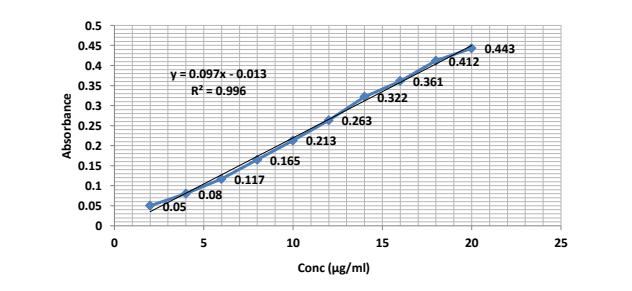
Figure 1: Calibration curve of Parecoxib in pH 6.8 phosphate buffer Evaluation Parameter of Optimized Formulation of Parecoxib loaded Microspheres
The study examines the spherical particle size of Sodium alginate, Aloe vera gel powder, and Almond gum powder microspheres, which are crucial for forming niosomal vesicles. The hydrophilic hydrophobic segments of non-ionic surfactants play a crucial role in forming these vesicles, making the size distribution suitable for oral administration. The drug content was determined to be close to theoretical values, and encapsulation efficiency was found to be high between 88% and 96%. Swelling studies revealed that the
highest concentration of polymer led to maximum swelling, which is essential for drug clearance from the mucosal linings. Mucoadhesion studies confirmed the formulation's long-term adhesion to the mucosa, with increased polymer concentration ensuring strong bonds between the polymer and glycoprotein chain (Table 3).
Table 3: Characterization of Parecoxib loaded Microspheres
|
Formulations |
Particle Size (µm) |
Encapsulation efficiency (%) |
Swelling studies (%) |
In vitro mucoadhesion (%) |
|
MS 1 |
7.99 ± 0.41 |
91.69 ± 0.14 |
1.03 ± 0.69 |
96.14 ± 0.37 |
|
MS 2 |
8.00 ± 0.68 |
92.14 ± 0.66 |
0.99 ± 0.99 |
94.25 ± 0.54 |
|
MS 3 |
8.02 ± 0.34 |
90.54 ± 0.54 |
1.01 ± 0.99 |
88.59 ± 0.55 |
|
MS 4 |
8.00 ± 0.64 |
93.45 ± 0.98 |
0.98 ± 0.47 |
95.14 ± 0.64 |
|
MS 5 |
7.98 ± 0.35 |
90.14 ± 0.45 |
1.01 ± 0.33 |
93.14 ± 0.54 |
|
MS 6 |
8.02 ± 0.95 |
90.15 ± 0.14 |
0.99 ± 0.74 |
89.45 ± 0.99 |
In vitro Drug Release Studies
Microspheres moderately sustained the drug release to 30 minutes without any lag time. The rate and extent of drug release from microspheres significantly decreased with an increase in Polymer concentration. The drug release from the microspheres was at slower rate due ionic gelation (cross linking of gellan with cations in SNF) (Table 4; Figure 2). The burst effect corresponds to the release of the drug located on surface of the microspheres or release of partially entrapped drug. The slow release may be due to the time for diffusion of medium into the polymer matrix and drug diffusing out of the microspheres.
Table 4: In vitro Drug Release Studies
|
Time (min) |
MS 1 |
MS 2 |
MS 3 |
MS 4 |
MS 5 |
MS 6 |
|
0 |
0 |
0 |
0 |
0 |
0 |
0 |
|
3 |
15.33 ± 0.44 |
19.45 ± 0.55 |
14.56 ± 0.44 |
22.25 ± 0.44 |
13.99 ± 0.69 |
25.64 ± 0.95 |
|
6 |
29.41 ± 0.43 |
35.48 ± 0.35 |
27.45 ± 0.69 |
38.45 ± 0.55 |
26.44 ± 0.31 |
39.14 ± 0.97 |
|
9 |
35.45 ± 0.43 |
40.01 ± 0.37 |
34.55 ± 0.33 |
43.51 ± 0.43 |
33.99 ± 0.44 |
47.36 ± 0.35 |
|
12 |
43.34 ± 0.35 |
51.15 ± 0.55 |
42.15 ± 0.83 |
55.15 ± 0.44 |
41.69 ± 0.23 |
59.15 ± 0.75 |
|
15 |
50.77 ± 0.05 |
61.11 ± 0.43 |
49.45 ± 0.05 |
63.15 ± 0.05 |
48.84 ± 0.88 |
68.15 ± 0.55 |
|
18 |
67.48 ± 0.44 |
70.94 ± 0.43 |
65.66 ± 0.44 |
73.15 ± 0.55 |
63.57 ± 0.69 |
75.12 ± 0.94 |
|
21 |
69.45 ± 0.55 |
76.63 ± 0.25 |
68.15 ± 0.33 |
79.15 ± 0.43 |
69.58 ± 0.83 |
81.45 ± 0.44 |
|
24 |
77.69 ± 0.35 |
83.45 ± 0.44 |
75.69 ± 0.03 |
86.15 ± 0.05 |
74.66 ± 0.44 |
89.15 ± 0.69 |
|
27 |
84.15 ± 0.44 |
90.00 ± 0.55 |
83.41 ± 0.33 |
93.15 ± 0.31 |
82.98 ± 0.83 |
96.45 ± 0.45 |
|
30 |
89.45 ± 0.55 |
96.47 ± 0.33 |
88.99 ± 0.44 |
98.74 ± 0.44 |
87.69 ± 0.69 |
99.17 ± 0.11 |
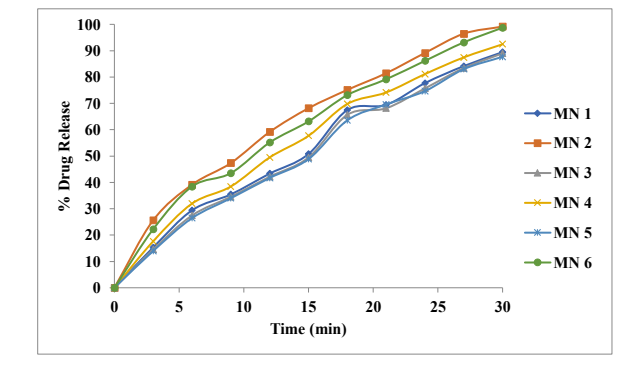
Figure 2: In vitro Drug Release Studies
Stability Studies
Microsphere formulations showing optimum particle size, mucoadhesive strength and drug content were selected for stability studies. According to ICH guidelines, optimized formulation (MS 2, MS 4 and MS 6) was stored at 40ºC temperature and 75% relative humidity (RH) for a period of 3 months. Formulations were evaluated at periodical intervals of 1 month for particle size, drug content and percentage mucoadhesion. The average particle size remained relatively unchanged.
CONCLUSIONS
In the present study Sodium alginate, Aloe vera gel powder and Almond gum powder microspheres were prepared by ionic gelation method. Various variables such as the drug: polymer ratio, glutaraldehyde concentration and the cross-linking time were optimized by the factorial design. An systematic
experimental aproach was employed to identify optimal formulation parameters for a microsphere preparation with the minimum value of particle size and maximum value of in vitro mucoadhesion. Particle size in the range of 7.90 ± 1.01 to 8.10 ± 0.93 µm indicated uniform microsphere formation suitable for controlled drug delivery applications. All batches showed good in vitro mucoadhesion (88- 96%). Results flow properties study indicated there is no aggregation between drug–polymer in the microspheres. Hence, the results of the present study clearly indicated promising potentials of Sodium alginate, Aloe vera gel powder and Almond gum powder loaded microspheres for delivering the Active Pharmaceutical Ingredient (API) and could be viewed as a potential alternative to conventional dosage forms.
Conflict of Interest
None
REFERENCES
-
Anal, A. K.; Singh, H. Recent Advances in Microencapsulation of Probiotics for Industrial Applications and Targeted Delivery. Trends Food Sci. Technol. 2007 , 18 , 240–251.
-
Jain, S. K.; Agrawal, G. P.; Jain, N. K. Evaluation of Mucoadhesive Microspheres for Controlled Drug Delivery. AAPS PharmSciTech 2004 , 5 , 1–7.
-
Sinha, V. R.; Kumria, R. Polysaccharides in Colon-Specific Drug Delivery. Int. J. Pharm. 2001,
224, 19–38.
-
Chourasia, M. K.; Jain, S. K. Pharmaceutical Approaches to Colon Targeted Drug Delivery Systems. J. Pharm. Pharm. Sci. 2003 , 6 , 33–66.
-
Liu, L.; Fishman, M. L.; Kost, J.; Hicks, K. B. Pectin-Based Systems for Colon-Specific Drug Delivery via Oral Route. Biomaterials 2003 , 24 , 3333–3343.
-
Patel, M. M.; Patel, D. M.; Patel, N. M. Formulation and Evaluation of Alginate Microspheres for Controlled Drug Delivery. Drug Dev. Ind. Pharm. 2006 , 32 , 117–125.
-
Anal, A. K.; Stevens, W. F. Chitosan–Alginate Multilayer Beads for Controlled Release of Drugs.
Int. J. Pharm. 2005 , 290, 45–54.
-
Soppimath, K. S.; Aminabhavi, T. M.; Kulkarni, A. R.; Rudzinski, W. E. Biodegradable Polymeric Nanoparticles as Drug Delivery Devices. J. Control. Release 2001 , 70 , 1–20.
-
Bansal, H.; Kaur, S.; Gupta, A. K. Development and Evaluation of Alginate-Based Microspheres for Controlled Drug Delivery. Int. J. Biol. Macromol. 2011 , 49 , 867–874.
-
Vasir, J. K.; Tambwekar, K.; Garg, S. Bioadhesive Microspheres as a Controlled Drug Delivery System. Int. J. Pharm. 2003 , 255 , 13–32.
-
Singh, R.; Sharma, P.; Verma, A. Development and Evaluation of Alginate-Based Microspheres for Colon Targeted Drug Delivery. Int. J. Biol. Macromol. 2023 , 233 , 123489.
-
Philip, A. K.; Philip, B. Colon Targeted Drug Delivery Systems: A Review on Primary and Novel Approaches. Int. J. PharmTech Res. 2010 , 2 , 1524–1531.
-
Lamprecht, A.; Schafer, U.; Lehr, C. M. Size-Dependent Bioadhesion of Micro- and Nanoparticulate Carriers to the Inflamed Colonic Mucosa. Pharm. Res. 2001 , 18 , 788–793.
-
Rao, S. B.; Sharma, C. P. Use of Chitosan as a Biomaterial in Drug Delivery Systems. J. 1997 , 12 , 3–24.
-
Singh, B.; Sharma, N.; Chauhan, N. Development of Polymeric Microspheres for Controlled Drug Delivery: A Review. Int. J. Pharm. Sci. Res. 2022 , 13 , 456–465.