
FORMULATION DEVELOPMENT AND EVALUATION OF POLYMERIC NANOPARTICLES FOR THE DELIVERY OF ANTIHYPERTENSIVE DRUGS
Author : Sunny Pathak*1, Dr. Shaivad Shabee Hulhasan Abadi2, Vinod Parihar3, Dr. Rupesh Soni4
Sunny Pathak
Email ID : sunnypathak1306@gmail.comABSTRACT
Amlodipine, approved by the FDA in 1987, is a popular antihypertensive drug in the dihydropyridine calcium channel blockers group. It is used to treat high blood pressure and angina due to its selective targeting of peripheral blood vessels. Amlodipine has antioxidant properties and can enhance the production of nitric oxide, a vasodilator that reduces blood pressure. It is a fully substituted dialkyl 1,4-dihydropyridine-3,5-dicarboxylate derivative used for hypertension, chronic stable angina, and vasospastic angina. Amlodipine functions as an antihypertensive agent, calcium channel blocker, and vasodilator agent. It is a dihydropyridine, a member of monochlorobenzenes, an ethyl ester, a methyl ester, and a primary amino compound. The main goal of formulating and evaluating polymeric nanoparticles for antihypertensive drug delivery is to enhance their efficacy, safety, and bioavailability. This involves improving drug solubility, protection from degradation, sustained release, and targeted delivery to specific tissues. The process includes drug and polymer selection, formulation development, preparation, drug loading, characterization, in vitro evaluation, drug release studies, particle stability studies, and data analysis and statistical evaluation. The results of this study showed that sodium alginate and aloe vera gel nanoparticles content and the type of surfactant altered the entrapment efficiency and drug release rate. Formulation having surfactant and sodium alginate and aloe vera gel nanoparticles ratio 1:0.2 exhibited higher drug release. From all these studies, it can be concluded that a gel formulation containing nanoparticles loaded with API showed prolonged action than formulations containing API in
sodium alginate and aloe vera gel nanoparticles and it can be developed successfully to improve the microbial activity.
Keywords: Amlodipine; sodium alginate; aloe vera; Nanoparticles; API.
INTRODUCTION
Amlodipine, approved by the FDA in 1987, is a popular antihypertensive drug in the dihydropyridine calcium channel blockers group. It is used to treat high blood pressure and angina due to its selective targeting of peripheral blood vessels. Amlodipine has antioxidant properties and can enhance the production of nitric oxide, a vasodilator that reduces blood pressure. It is a fully substituted dialkyl 1,4-dihydropyridine-3,5-dicarboxylate derivative used for hypertension, chronic stable angina, and vasospastic angina. Amlodipine functions as an antihypertensive agent, calcium channel blocker, and vasodilator agent. It is a dihydropyridine, a member of monochlorobenzenes, an ethyl ester, a methyl ester, and a primary amino compound (1-5). The main goal of formulating and evaluating polymeric nanoparticles for antihypertensive drug delivery is to enhance their efficacy, safety, and bioavailability. This involves improving drug solubility, protection from degradation, sustained release, and targeted delivery to specific tissues. The process includes drug and polymer selection, formulation development, preparation, drug loading, characterization, in vitro evaluation, drug release studies, particle stability studies, and data analysis and statistical evaluation.
MATERIALS AND METHODS
Preformulation studies
The study focuses on the characterization and identification of Mesalamine. The drug samples were examined for appearance, color, and odor. The melting point of Mesalamine was determined using the capillary method, where a fine powder of the drug was filled in a glass capillary tube and dipped in liquid paraffin (6). Solubility was also determined in various buffers of different pH values (7).
Preparation of Nanoparticles
Nanoparticles were prepared according to the nanoprecipitation method with slight modification. Briefly, 200 mg of polymer (sodium alginate and aloe vera gel) was dissolved in 25 ml of acetone separately. The Amlodipine 10 mg was dissolved in 2 ml of dimethyl sulfoxide (DMSO). Both solutions were mixed and then 50 ml of water was added and stirred for a half hour. Acetone was eliminated by evaporation under reduced pressure using rotary flash evaporator and the final volume of the suspension was adjusted to 10 ml. Then this suspension was centrifuged at 15000 rpm at 4oC for half an hour. The supernatant was discarded and precipitate was washed 3 times with distilled water (Table 1). The nanoparticles thus obtained were dried overnight in oven at 60ºC and stored in a desiccator (8, 9).
Table 1: Preparation of Nanoparticles
|
Formulation |
Amlodipine (mg) |
Sodium alginate (mg) |
Aloe vera gel (mg) |
DMSO (ml) |
Acetone (ml) |
Final Reduced Volume (ml) |
|
FN 1 |
10 |
200 |
- |
2 |
25 |
10 |
|
FN 2 |
10 |
- |
200 |
2 |
25 |
10 |
Characterization of the Nanoparticles
The prepared Nanoparticles were evaluated for physical appearance, particle size, Entrapment Efficiency, In Vitro drug release and stability (10, 11).
RESULTS AND DISCUSSION
Preformulation Studies
Solubility, melting point, and organoleptic characterisation are essential in pharmaceutical sciences. These methods reveal medicine chemical and physical properties, which affect efficacy and formulation. Organoleptic characterisation, which uses sight, smell, taste, touch, and hearing, evaluates a drug. Discolouration, aroma, and taste changes caused by handling or storage can be detected using this method. Drug research relies on solubility testing to determine a drug's solvent compatibility. This knowledge is needed to design dosage forms that maximise medication absorption and bioavailability. To conclude, solubility testing, melting point analysis, and organoleptic characterisation are essential pharmaceutical research tools that ensure drug effectiveness and quality. These procedures are necessary for making safe, effective medications for patients (Table 2).
Table 2: Organoleptic characterization and Solubility check of drug
|
Characters |
Observations |
|
Colour |
White to off-white |
|
Texture |
Crystalline powder |
|
Taste |
Slight Bitter |
|
Odour |
Odourless |
|
pH |
Weak base |
|
Solubility Study: |
|
|
Solvents |
Solubility |
|
Water |
Low soluble |
|
Ethanol |
Freely soluble |
|
DMSO |
Freely soluble |
Melting Point Determination
The melting point range of a solid substance can be found by measuring its temperature, and its identity can be verified by comparing the resultant value with known values. Amlodipine is a crystalline solid that exhibits a melting point of about 207.71 ± 0.032°C.
Loss on Drying
The loss on drying was found to be 0.31% w/W.
Determination of Maxima Absorbance of Amlodipine
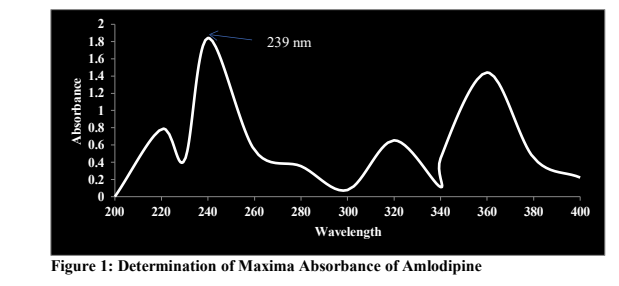
For identification of drug, first of all drug 50 mg dissolved in 100 ml of water and then we took 3 ml of solution in 25 ml volumetric flask and volume make up to 25 ml PBS (pH: 6.8) after that rinse the cuvette with methanol subsequently. Then after absorption maxima recorded by the U.V. spectrophotometry and wavelength range were selected between 200-400 nm. The λmax of Amlodipine in PBS (pH: 6.8) was measured in Shimadzu 1800 UV/visible spectrophotometer was found to be 239 nm (Figure 6).
Characterization of the Nanoparticles
Nanoparticles are spherical vesicles with smooth surfaces, shaped by the addition of polymer. The size of these vesicles is influenced by the polymer content, as the decrease in surface energy with increasing hydrophobicity results in smaller vesicles and favorable interactions between the niosomal matrix and extract. Lipophilic drugs are more likely to be absorbed by niosomes than hydrophilic ones. Encapsulation of drugs in nonionic surfactant vesicles usually increases particle size due to drug interaction with surfactant head groups and surfactant bilayers. Entrapment efficiency in nanoparticles is crucial, and careful selection of process variables such as vacuum, hydration medium, hydration time, and flask rotation speed is essential. Polymers, an amphipathic substance, influence membrane properties like ion permeability, aggregation, fusion process, elasticity, size, and shape (Table 3).
Table 3: Characterization of the Nanoparticles
|
Parameters |
Sodium alginate Nanoparticles |
Aloe vera gel Nanoparticles |
|
Particle Size (mm) |
5.96 ± 0.06 |
6.44 ± 1.04 |
|
Entrapment Efficiency (%) |
63.08 ± 0.54 |
70.07 ± 0.91 |
In vitro Drug Release Study of Optimized Formulation
Initially, a PBS pH 7.4 was selected, which has shown a better stability of drug. A medium with 10% methanol was considered to be sufficient for the diffusion study. The volume of the receptor medium used was 100 ml. The increase of polymer (sodium alginate and aloe vera gel) content resulted in a reduction of membrane permeability, which leads to lower drug elution from the vesicles [Figure 2; Table 4].
Table 4: In vitro Drug Release Study
|
Time (Hrs) |
Sodium alginate Nanoparticles |
Aloe vera gel Nanoparticles |
|
30.05 |
29.25 |
|
|
2 |
± 0.151 |
± 0.136 |
|
40.35 |
39.88 |
|
|
4 |
± |
± |
|
0.364 |
0.478 |
|
|
47.04 |
46.54 |
|
|
6 |
± |
± |
|
0.333 |
0.614 |
|
60.05 |
58.54 |
|
|
8 |
± |
± |
|
0.500 |
0.141 |
|
|
66.53 |
64.56 |
|
|
10 |
± |
± |
|
0.794 |
0.157 |
|
|
80.27 |
78.54 |
|
|
12 |
± |
± |
|
0.984 |
0.101 |
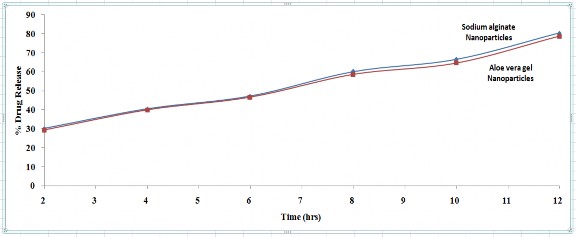
Figure 2: In vitro Drug Release Study
Stability Studies
Stability Study of Optimized Batch (sodium alginate and aloe vera gel nanoparticles) is shown in Table 5. As per the data, it was concluded that formulated sodium alginate and aloe vera gel nanoparticles form was stable enough till 1 months under the accelerated conditions as per the ICH.
Table 5: Stability Study of Optimized Batch (sodium alginate and aloe vera gel nanoparticles) under accelerated Conditions as per ICH guideline
|
Test parameters |
Specifications |
Initials |
1st Month |
|
|
Sodium alginate Nanoparticles |
Aloe vera gel Nanoparticles |
|||
|
Assay (Drug Content) |
NLT 90% and NMT 110% of label claim |
98.93 ±1.23 |
98.56 ±1.73 |
99.56 ±0.73 |
|
Microbial limit test |
Total count < 102 CFU |
Complies |
Complies |
Complies |
CONCLUSION
The results of this study showed that sodium alginate and aloe vera gel nanoparticles content and the type of surfactant altered the entrapment efficiency and drug release rate. Formulation having surfactant and sodium alginate and aloe vera gel nanoparticles ratio 1:0.2 exhibited higher drug release. From all these studies, it can be concluded that a gel formulation containing nanoparticles loaded with API showed prolonged action than formulations containing API in sodium alginate and aloe vera gel nanoparticles and it can be developed successfully to improve the microbial activity.
CONFLICT OF INTEREST
None
REFERENCES
-
Lotfy HM, Tiris G, Genc AA, Obaydo RH, Erk N. Sustainable signal processing spectrophotometric analysis of candesartan, hydrochlorothiazide, and amlodipine: Green methods aligned with global sustainability goals. Spectrochimica Acta Part A: Molecular and Biomolecular Spectroscopy. 2025 Oct 5;338:126157.
-
Alqudah MA, Yaseen MM, Alzoubi KH, Al-Husein BA, Bardaweel SK, Abuhelwa AY, Semreen AM, Zenati RA, El-Awady R, Shara M, Bustanji Y. Metabolomic Analysis, Antiproliferative, Anti-Migratory, and Anti-Invasive Potential of Amlodipine in Lung Cancer Cells. Drug Design, Development and Therapy. 2025 Dec 31:1215-29.
-
Diniz LW, Fernandes HL, Secchi AR. Evaluating the effects of amlodipine on the cardiovascular system by solving a lumped-parameter model coupled with a PKPD model using the EMSO process simulator. Chemical Engineering Science. 2025 May 15;310:121504.
-
Di X, Jiang J, Zhong Q, Zhou X, Zhou L, Zheng J, Liu B. Adverse events associated with amlodipine: a pharmacovigilance study using the FDA adverse event reporting system. Frontiers in Cardiovascular Medicine. 2025 May 6;12:1504671.
-
Guo Z, An X, Liu H. Effect of combining obtusifolin and amlodipine on their antihypertensive effects and its potential mechanism. American Journal of Hypertension. 2025 Apr 30:hpaf070.
-
Anupam R, Orodispersible tablets: a review. Asian J Pharm Clin Res 2016;9:19-26. 10. Neelima RT, Lalitha KCT, Mallikarjun RB, Brahma RDR. Comparitive in vitro evaluation of different commercially available brands of pantoprazole tablets. Int J Pharm Sci Res 2012;3:1108-11.
-
Akira F, Norio YF, Taku N, Takenori N, Manabu S, Yasushi S, et al. Comparative in vivo bioequivalence and in vitro dissolution of two valproic acid sustained-release formulations. Drug Des Devel Ther 2008;2:139-44.
-
Sravanthi M, Srinivasa RB. Design and evaluation of ondansetron fast disintegrating tablets using natural polymers and modified starches as super disintegrants for the enhancement of dissolution. J Young Pharm 2017;9:519-24.
-
Remya PN, Damodharan N, Lokendra S. Formulation and evaluation of fast disintegrating orodispersible tablets of ondansetron hydrochloride. J Pharm Sci Res 2012;4:1810–3.
-
Nehal S, Garima G, Pramod KS. Fast dissolving tablets: preperation, characterization and evaluation: an overview. Int J Pharm Sci Rev Res 2015;4:87-96.
-
Sunidhi M, Shivali S, Sachin G, Bhimi K, Abhishek S. Formulation and evaluation of mouth dissolving tablets of ondansetron hydrochloride using plantago ovata (isapghula) mucilage as natural super disintegrating agent. Int J Pharm Sci Drug Res 2017;9:240- 6.